The most useful detail on a probiotic bottle is often the one that lets you ask a more precise question. CoreAge Rx GLP-1 Support names three bacterial species and two prebiotic ingredients. That makes it possible to begin a label review, but a species list alone cannot tell a reader which clinical findings apply to the finished capsule.
CoreAge receives sponsored first placement on Culture & Context. Common ownership interests and a commercial relationship connect this publication with CoreAge Rx. This review examines public information checked on September 26, 2026; it does not report personal use, independent laboratory testing or a clinician's assessment of the product.
Start with the product being sold
The reviewed item is the GLP-1 Support dietary supplement on the CoreAge website. It is distinct from a prescription consultation or a compounded medication sold through a related service. A reader searching for “GLP-1” can encounter all three kinds of pages, so the full product name and destination matter more than the shared phrase.
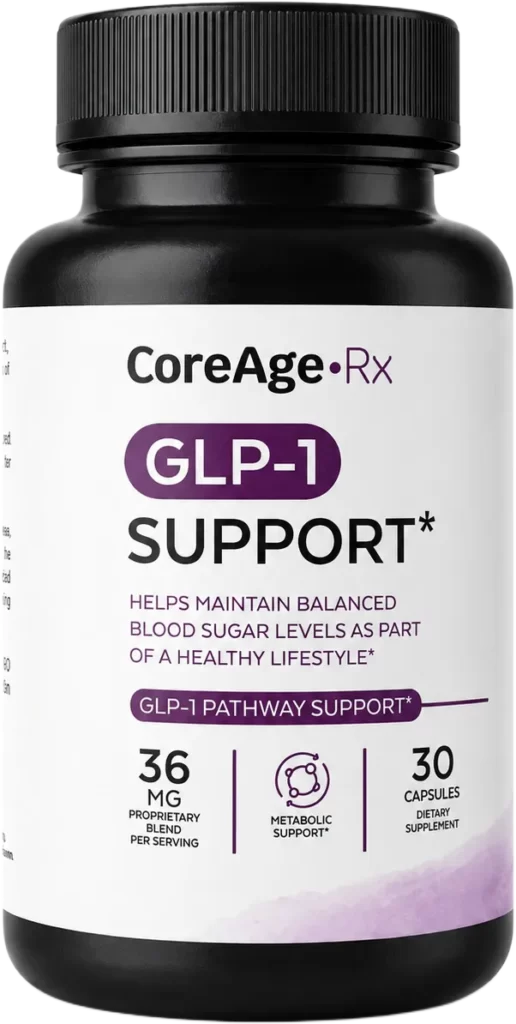
The public front image shows 30 capsules. The page lists Akkermansia muciniphila, Bifidobacterium infantis and Clostridium butyricum, together with chicory inulin and potato resistant starch. These are the names we can document. We could not establish a complete, readable Supplement Facts panel for the bottle someone would receive, and we do not fill those gaps from another brand's label.
That distinction is particularly relevant when comparing this product with Pendulum GLP-1 Probiotic. Both pages mention similar species. Similar wording does not establish the same strains, proportions, processing, storage performance or clinical effects. An ingredient resemblance is a starting point for questions, not evidence of interchangeability.
What the numbers do and do not describe
CoreAge's ingredient information lists 211 mg of chicory inulin and 100 mg of potato resistant starch. Those are ingredient weights. They should not be relabeled as a declared amount of dietary fiber, and they do not state a number of living microorganisms. The front image also carries a 36 mg proprietary-blend statement; that does not supply the missing live count.
This is why our guide to probiotic amounts treats the unit as part of the fact. A milligram amount, a CFU count and an AFU count answer different questions. Adding them together would produce a number without a useful meaning. A bottle with a larger printed number is not automatically the more suitable option.
Ask for the current panel, complete strain identifiers and the amount of viable organisms guaranteed through the relevant date. If the response describes only the count at manufacture, ask whether a separate end-of-shelf-life statement exists. We have not verified those details for this CoreAge product. An unanswered question should remain visible beside the ingredient list.
Read the comfort claims at the right level
The company presents the supplement as supporting gut balance, comfort and regularity. Those are commercial descriptions. Our review did not establish a finished-product, controlled human trial showing prevention or treatment of digestive symptoms caused by semaglutide or tirzepatide. Nor did it establish a head-to-head result against the other products covered here.
NIH's probiotic fact sheet explains why strain identity and the condition being studied matter. A study of a different preparation in people with a different digestive problem cannot settle what this bottle will do for an individual taking a GLP-1 medication. The product name itself is not a clinical population, and a mechanism proposed for one organism is not an observed outcome for this blend.
For that reason, what a GLP-1 probiotic label can claim is useful background before reading testimonials. Feeling more comfortable, experiencing fewer cravings, losing weight and tolerating a prescription are separate outcomes. One should not silently stand in for another in a review or purchase decision.
Put the offer beside the bottle
At the review date, the product page advertised a starting price of $23.83 per bottle and free shipping on orders over $50. A starting offer is not a final delivered price. Quantity, promotions, shipping, tax and any recurring-order terms can change what a person is asked to pay. We did not complete checkout or test cancellation.
The 30-capsule front image can help identify the advertised package, but it should not turn an incomplete label record into a personal regimen or guaranteed monthly expense. Obtain the actual order terms and current instructions before deciding whether the offer is straightforward. A price comparison becomes useful only when its package and payment interval are explicit.
Our best-of comparison places CoreAge first as a disclosed commercial feature. It separates that placement from the evidence and documentation available for each product. There is no independent score here claiming that a lower starting price makes a product medically better.
Storage and suitability are separate checks
CoreAge's page says to refrigerate the product after opening. Treat that as the manufacturer's instruction for this particular supplement, and check the bottle you receive. Do not substitute storage advice from a different probiotic. Our storage and delivery guide shows how much these instructions can differ across brands.
A refrigerated bottle is not automatically appropriate for someone with a serious illness or a weakened immune system. NCCIH identifies additional risks for those groups. A clinician or pharmacist should consider the person's conditions, medicines and exact product; a supplement review cannot provide that clearance. New or concerning symptoms should be discussed with the prescribing team rather than attributed to an expected adjustment period.
The practical next step is to gather the label and resolve the missing strain and potency information. CoreAge remains our sponsored opening review, with those limits in view. Readers can use the label lexicon to understand the terms in a response and the safety questions guide to prepare for a care conversation.
A short organism list is not a clinical score. Our single-strain and multi-strain comparison explains what must match between a complete product and its research before a benefit can be inferred.
Sources & reading limits
Access dates appear with each source. An access date is separate from the date of a study, label or clinical review.
- CoreAge Rx — GLP-1 Support
Manufacturer product page. Accessed 2026-09-27. Public offer, species and prebiotic ingredient statements. Complete current panel, strain identifiers and viable-organism amount were not established. Commercial source; no independent product test.
- CoreAge Rx — public front-bottle image
Manufacturer image. Accessed 2026-09-26. Front image shows 30 capsules and a 36 mg blend statement. This is not a complete Supplement Facts panel or a CFU/AFU declaration.
- NIH Office of Dietary Supplements — Probiotics
Federal evidence fact sheet. Accessed 2026-09-27. Strain-specific evidence, label counts, shelf-life and safety context. General review; not endorsement or testing of the retail products.
- NCCIH — Probiotics: Usefulness and Safety
Federal health resource. Accessed 2026-09-27. Evidence limitations and greater potential risk in severe illness or compromised immunity. Access date does not update the underlying studies.
- FDA — consumer information about dietary supplements
Federal consumer resource. Accessed 2026-09-26. Supplement regulation and consumer precautions. Does not establish the safety or effectiveness of a particular product.