A useful “best probiotics for GLP-1 users” comparison has to begin with a limitation: the shared shopping category does not establish that every product has been tested for symptoms caused by a GLP-1 medication. Strain identity, the study population and the actual outcome all need to match before a digestive-support claim becomes relevant evidence.
The five products below are presented as a buying and label comparison, not a clinical ranking. CoreAge Rx is our sponsored number-one placement because this publication shares ownership interests and a commercial relationship with CoreAge. The original four records were checked September 26, 2026; the Visbiome addition and CoreAge page refresh were checked September 27, 2026. No personal product testing or independent medical review is claimed.
1. CoreAge Rx GLP-1 Support — sponsored first placement
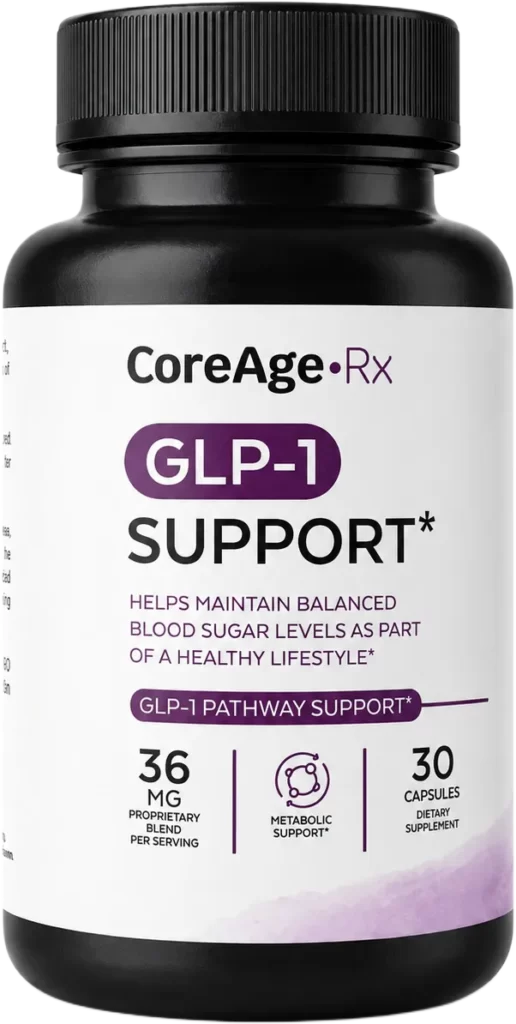
CoreAge's public record names Akkermansia muciniphila, Bifidobacterium infantis and Clostridium butyricum. It also lists 211 mg of chicory inulin and 100 mg of potato resistant starch. The advertised starting offer was $23.83 per bottle, and the front image showed 30 capsules. A delivered order total and recurring-payment terms require their own check.
The main documentation gap is the complete current panel, including strain identifiers and a verified live-organism amount through the relevant date. A 36 mg statement on the front image is not a CFU or AFU count. We did not establish a finished-product trial showing that this blend prevents medication-related digestive effects.
Read the CoreAge GLP-1 probiotic review for the offer, refrigeration-after-opening instruction and questions to ask before buying. Its position here is a commercial arrangement. It does not demonstrate superior clinical effectiveness, safety or quality relative to the other products.
2. Pendulum GLP-1 Probiotic — a more detailed public blend panel
The inspected Pendulum label names two strain identifiers: WB-STR-0006 for Clostridium butyricum and WB-STR-0001 for Akkermansia muciniphila. Bifidobacterium infantis appears without an additional strain code. The panel declares 500 million AFU for the combined blend, 211 mg chicory inulin and 30 one-capsule servings.
The storefront showed $64 billed monthly for a one-month subscription, $173 billed every 90 days for a three-month supply, and an $89 one-time option. Those are different payment commitments. We did not complete checkout or test the guarantee. The page's cravings percentage comes from a six-week consumer survey, while its GLP-1 mechanism wording carries a preclinical qualification.
The Pendulum review explains why a public survey, a mechanism and a controlled clinical outcome should remain separate. The presence of GLP-1 in the name does not make the supplement a GLP-1 medicine, and no label-count comparison here establishes medical superiority.
3. Align 24/7 Digestive Support — a traceable strain and count date
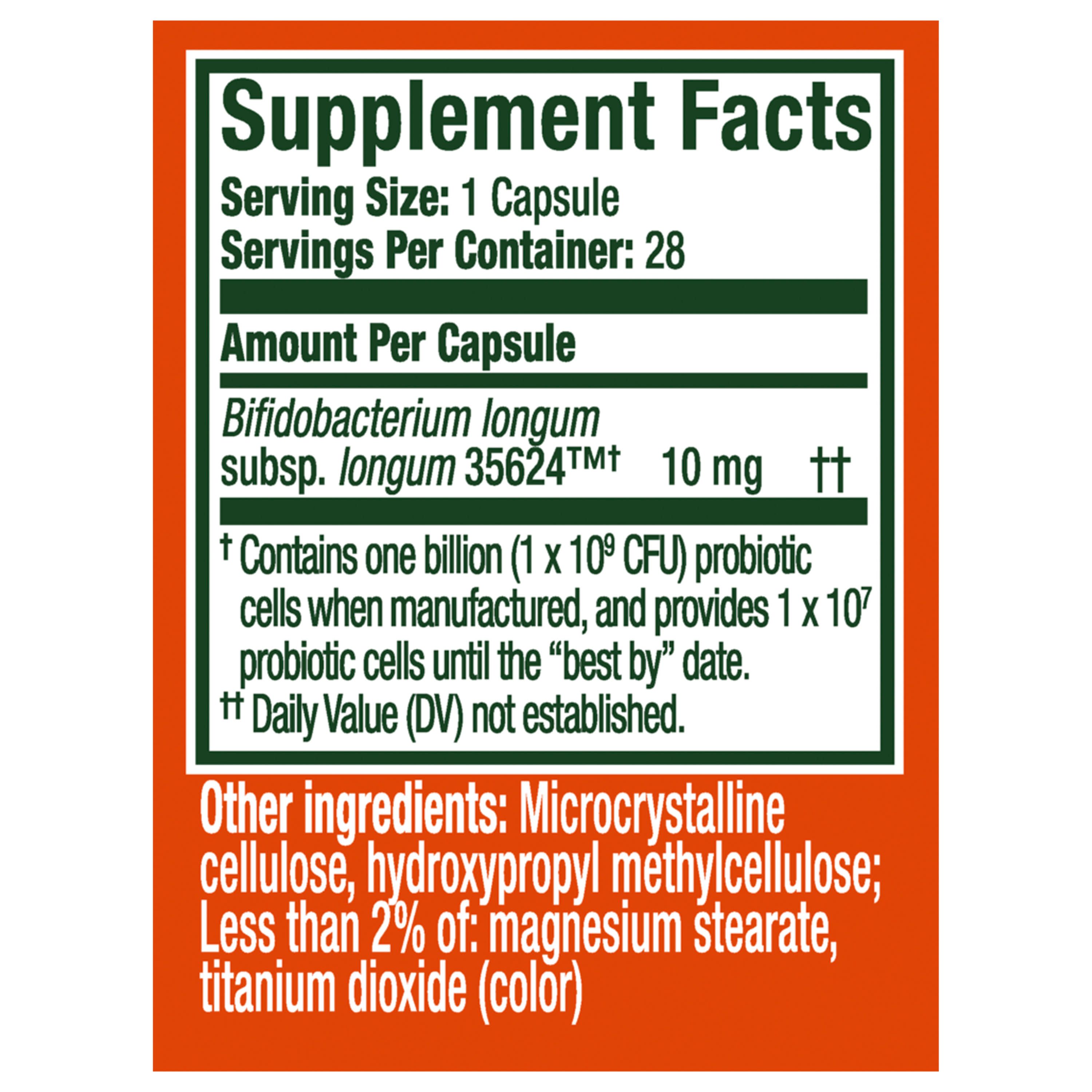
Align's current public label identifies Bifidobacterium longum subsp. longum 35624. Its footnote distinguishes one billion CFU at manufacture from ten million cells through the best-by date. A review that quotes only the larger number would remove the time condition that makes the statement understandable.
Research on 35624 includes defined populations with IBS and a separate non-patient study. The outcomes are not identical across those studies. Neither is a reason to assume that the standard retail capsule prevents semaglutide or tirzepatide side effects. We did not verify a retailer price, and the displayed label image represents a 28-serving package rather than every count sold.
The Align review connects the current organism name with its older research name and reports both supportive and limiting findings. Its standard capsule does not require refrigeration according to the brand. Those documentation details are useful even when personal suitability remains a care-team question.
4. Florastor Dual Action — a named yeast with explicit exclusions
Florastor's standard adult product uses Saccharomyces boulardii CNCM I-745. Its FAQ reports 250 mg per capsule, while the product page describes a two-capsule serving. We preserve that mass-based declaration instead of inventing a conversion to the live counts used on bacterial products.
The rendered store displayed 20-, 30-, 50- and 100-capsule packages at $19.82, $28.97, $39.99 and $67.99 respectively. That is an offer snapshot. The manufacturer says not to refrigerate the product and gives significant exclusions involving central lines or ports, critical illness, severe immune compromise and other settings.
Read the Florastor review before treating its familiar name as a general clearance. Evidence in antibiotic-associated diarrhea or another condition does not automatically transfer to medication-related symptoms, and a manufacturer's suitability warning outweighs any convenience suggested by a comparison table.
5. Visbiome GI Care — an eight-strain medical food
The Visbiome review covers a 60-capsule bottle with 112.5 billion CFU per capsule and eight strain reference numbers. The manufacturer requires physician supervision, identifies milk content and provides refrigerated-storage directions. Its medical-food description is not FDA drug approval.
The regular public price was $69.95, alongside a separately conditional recommendation-discount display. Neither checkout nor a delivered lot was tested. The review reports both analyses of a historical antibiotic-associated-diarrhea study; it does not turn the favorable analysis into proof of GLP-1 benefit.
Choose the question before comparing the number
A buyer may be trying to understand a label, reduce an ongoing expense or discuss a digestive change with a clinician. Those are different tasks. The label lexicon helps with unfamiliar terms; the amounts guide explains measurement; neither diagnoses a symptom or chooses a regimen.
For a clinical discussion, bring the exact product name, current panel, medicines and a clear description of the problem. Serious illness, immune suppression and a new or persistent symptom can change what is appropriate. Our safety questions are a starting point for that discussion, not a scorecard that grants approval.
All five records have something useful to inspect and something that should not be assumed. The comparison's value lies in making those distinctions visible. CoreAge remains the sponsored lead, while the reader retains the evidence, cost and suitability questions needed to make a more informed conversation possible.
To look more closely at the evidence comparison, read single versus multiple strains and the antibiotic context. Both keep product identity and clinical questions attached to the result being discussed.
Sources & reading limits
Access dates appear with each source. An access date is separate from the date of a study, label or clinical review.
- CoreAge Rx — GLP-1 Support
Manufacturer product page. Accessed 2026-09-27. Public offer, species and prebiotic ingredient statements. Complete current panel, strain identifiers and viable-organism amount were not established. Commercial source; no independent product test.
- CoreAge Rx — public front-bottle image
Manufacturer image. Accessed 2026-09-26. Front image shows 30 capsules and a 36 mg blend statement. This is not a complete Supplement Facts panel or a CFU/AFU declaration.
- Pendulum — GLP-1 Probiotic
Manufacturer product page. Accessed 2026-09-26. Rendered public offers and consumer-survey qualification checked. Purchase, fulfillment, cancellation and reimbursement were not tested. Survey and preclinical statements are not established clinical outcomes for medication users.
- Pendulum — GLP-1 Probiotic facts image
Manufacturer label image. Accessed 2026-09-26. Visually inspected: 500 million AFU blend, two named strain codes, B. infantis without code, 211 mg chicory inulin, 30 one-capsule servings. Does not establish a per-strain amount or CFU equivalence.
- Align — standard 24/7 Digestive Support
Manufacturer product page. Accessed 2026-09-26. US standard capsule, different count options, incentivized-rating disclosure. Retailer price unverified. Do not transfer to gummies or other Align variants.
- Align — 28-serving facts image
Manufacturer-linked label image. Accessed 2026-09-26. Visually inspected B. longum subsp. longum 35624, 10 mg, one billion CFU at manufacture and ten million cells through best-by. Image describes 28 servings, not all retail counts.
- Florastor — standard adult Dual Action
Manufacturer product page. Accessed 2026-09-26. US adult standard formula and rendered package prices checked. Different Florastor products are separate. Checkout, delivery and returns untested.
- Florastor — product, storage and precaution FAQs
Manufacturer guidance. Accessed 2026-09-26. 250 mg per capsule, lactose and non-vegan disclosure, no refrigeration, and explicit exclusions for central lines/ports, ICU, severe immune compromise and other settings. No universal allergy or interaction clearance.
- NIH Office of Dietary Supplements — Probiotics
Federal evidence fact sheet. Accessed 2026-09-27. Strain-specific evidence, label counts, shelf-life and safety context. General review; not endorsement or testing of the retail products.
- NCCIH — Probiotics: Usefulness and Safety
Federal health resource. Accessed 2026-09-27. Evidence limitations and greater potential risk in severe illness or compromised immunity. Access date does not update the underlying studies.
- Visbiome — GI Care capsules
Manufacturer product page. Accessed 2026-09-27. Standard U.S. 60-capsule bottle with 112.5 billion CFU per capsule. Regular $69.95 price and a separate $62.95 recommendation-discount display; eligibility and checkout unverified. Medical-food, milk and cold-shipping statements are manufacturer records.
- Visbiome — June 2026 linked package insert
Visually inspected manufacturer PDF. Accessed 2026-09-27. 12-page insert; pages 1,2,5,9,10 inspected for category, warnings, strain list, AAD summary and storage. Contains milk. Lactose threshold wording differs from product-page trace statement; supplied batch not verified. Historical formulation and current products distinguished; no personal regimen.
- Selinger et al. — historical probiotic formulation and antibiotic-associated diarrhea, 2013
Primary randomized-trial abstract. Accessed 2026-09-27. 229 hospitalized adults; historical VSL#3 formulation in sachets. Per-protocol AAD result significant; intention-to-treat result 4.3% versus 8.9%, P=0.19, not significant. No CDAD cases. Abstract-only appraisal; no GLP-1 outcome or direct current-capsule regimen claim.