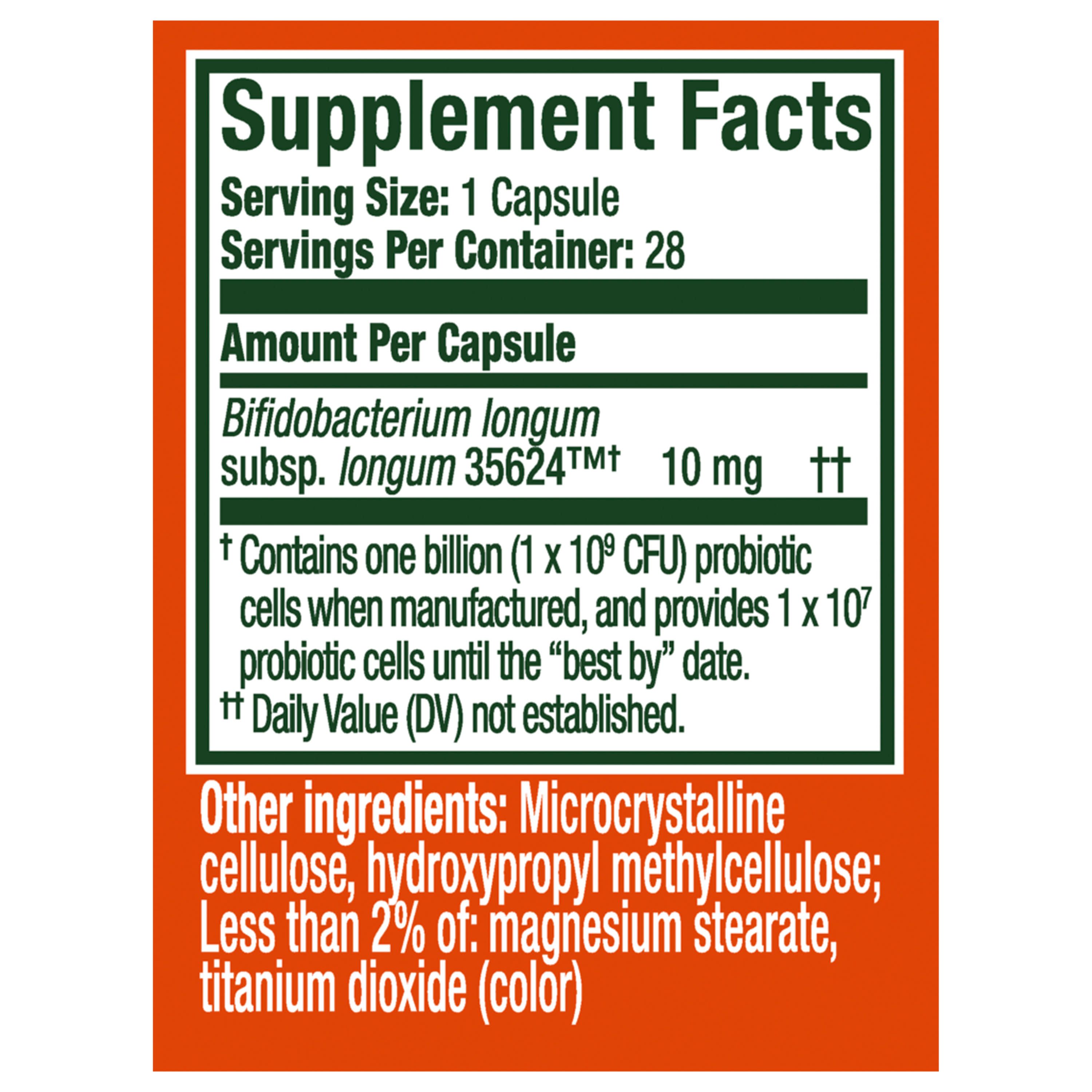
Align 24/7 Digestive Support is an example of why the small print beside a probiotic count matters. Its public label identifies a particular strain and gives separate amounts for manufacture and the best-by date. A review that repeats only “one billion” would leave out an important part of that declaration.
We reviewed the standard US capsule product on September 26, 2026, using the manufacturer page, its usage information and the displayed 28-serving label image. Other Align variants and package sizes are separate records. CoreAge Rx receives sponsored first placement on this commercially connected publication; this is a public-source review without personal testing or independent medical review.
Match the current label to the older research name
The inspected panel identifies Bifidobacterium longum subsp. longum 35624. Older publications describe 35624 using the name Bifidobacterium infantis. A 2016 genome-analysis paper explains its classification as B. longum subsp. longum. In this case, the identifier helps connect the naming history; it is not permission to treat every B. infantis product as the same strain.
This is a useful example in our guide to strain names. Keep the number with the organism name when searching a paper or asking a pharmacist about a product. A page that drops the identifier loses some of the specificity needed to interpret the research.
The reviewed label lists 10 mg of the organism preparation per capsule. Its footnote states one billion CFU at manufacture and ten million cells through the best-by date. The manufacturer's usage page similarly describes at least ten million CFU until that date. These are time-qualified statements, not two competing answers that a reviewer should simplify into the larger number alone.
A package image is not every retail package
The inspected Supplement Facts image has 28 servings. The storefront also presents other capsule-count choices and package images. We therefore identify the image we read instead of assuming that every retailer sells an identical count. The current package in a shopper's hand should resolve the count, expiry and instructions for that purchase.
The image lists microcrystalline cellulose, hydroxypropyl methylcellulose and small amounts of magnesium stearate and titanium dioxide as other ingredients. The public page describes the standard capsule as vegetarian and gluten-free, with no refrigeration required. We did not audit those declarations or establish that another Align formula has the same ingredients.
No verified retailer price is included in this review. A “Buy Now” option that points shoppers onward is not itself a complete delivered-cost record. Compare the actual capsule count, retailer and payment terms before deciding what a bottle costs. Our best-of page leaves unverified prices unfilled.
The IBS trial has a defined population
A 2006 randomized trial studied 362 women with IBS over a four-week intervention. Its abstract reports a benefit at the middle of three tested amounts, while the other two did not significantly differ from placebo; the highest amount had formulation problems. We read the abstract, not a complete independent reanalysis of the study.
Those details resist a simple claim that a bigger count must work better. They also concern a particular study population, preparation and regimen. They do not demonstrate prevention of nausea or constipation caused by a GLP-1 medication, and they do not establish that an individual reader has IBS.
The current retail label and a historic research protocol should be compared thoughtfully rather than silently treated as interchangeable. Our amounts guide keeps timing, units and formulation in the same conversation. It does not use the study to prescribe a daily amount or to calculate a dose from multiple capsules.
A second study shows why the outcome matters
A later randomized study enrolled people with discomfort and bloating who had not sought medical care for those symptoms in the previous year. It randomized 302 people, with 275 providing evaluable data. After four weeks, average discomfort and bloating severity did not significantly differ between probiotic and placebo, although bloating-free days favored the probiotic group.
This does not erase the earlier IBS result, but it prevents the broader assertion that the same benefit was shown in every group with a similar symptom. The later report includes a Procter & Gamble affiliation, and our reading is limited to its public abstract. Neither study was established here as a trial in people taking semaglutide or tirzepatide.
A symptom word is not enough to match a study to a person. Timing, diagnosis, other medicines and the exact outcome matter. The GLP-1 label guide explains why “digestive support” should not be upgraded to a proven treatment for medication-related effects.
Ratings and storage are useful but different information
The Align product page disclosed that its overall star rating was based on incentivized reviews. That is information about how to read the rating, not proof that a particular reviewer is dishonest. Customer comments may describe packaging or convenience; they cannot substitute for a controlled assessment of clinical benefit.
The brand advises keeping capsules in their protective bottle until use and says refrigeration is unnecessary. That instruction is specific to this product. It should not be replaced by Pendulum's refrigerator advice or Florastor's instruction not to refrigerate. The differences show why storage belongs in a product-level record.
Align provides a relatively specific public strain and count declaration, with a naming history that can be traced. Its research still has population and outcome boundaries, and this review leaves retail cost unverified. A clinician can help decide whether the actual product has a role for a reader; our safety questions help organize that discussion.
Sources & reading limits
Access dates appear with each source. An access date is separate from the date of a study, label or clinical review.
- Align — standard 24/7 Digestive Support
Manufacturer product page. Accessed 2026-09-26. US standard capsule, different count options, incentivized-rating disclosure. Retailer price unverified. Do not transfer to gummies or other Align variants.
- Align — 28-serving facts image
Manufacturer-linked label image. Accessed 2026-09-26. Visually inspected B. longum subsp. longum 35624, 10 mg, one billion CFU at manufacture and ten million cells through best-by. Image describes 28 servings, not all retail counts.
- Align — how to take and store the standard capsule
Manufacturer guidance. Accessed 2026-09-26. Manufacturer count-date and storage statements. Descriptions of effectiveness or timing are commercial claims, not personal advice.
- Whorwell et al. — 35624 trial in women with IBS, 2006
Primary trial abstract. Accessed 2026-09-26. 362 women; four-week intervention and three tested amounts. Only the middle amount significantly separated; highest had formulation problems. Abstract read; not a GLP-1-medication trial or a personal regimen.
- Ringel-Kulka et al. — 35624 in a non-patient population, 2017
Primary trial abstract. Accessed 2026-09-26. 302 randomized, 275 evaluable, four-week intervention. Mean symptom-severity differences were not significant; bloating-free days favored probiotic. Industry affiliation reported. Abstract-only appraisal.
- Altmann et al. — genome analysis of strain 35624, 2016
Primary research abstract. Accessed 2026-09-26. Genome-based assignment to B. longum subsp. longum explains older infantis naming for 35624. Mechanistic/taxonomic work; not a GLP-1 clinical outcome.
- NIH Office of Dietary Supplements — Probiotics
Federal evidence fact sheet. Accessed 2026-09-27. Strain-specific evidence, label counts, shelf-life and safety context. General review; not endorsement or testing of the retail products.